
Redefining Hospitality and Catering
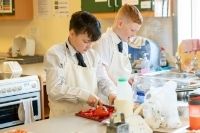
- Understand and apply the principles of nutrition and health.
- Cook a selection of healthy savoury dishes for themselves and others.
- Show mastery in a range of skills in food preparation and also include techniques of adapting recipes to suit an individual`s health needs.
- Understand the source, reasonability, and characteristics of a broad range of ingredients.
- Gain knowledge and understanding of skills relating to a specific vocation
- Develop the essential skills that are valued by employers, further and higher education.
Year 7
Year 7 Basics in Food carousel introduces students to fundamental food preparation, nutrition, and kitchen safety skills through a range of engaging practical activities and theory lessons. Students learn how to work safely and hygienically in the food room, use equipment correctly, and develop essential techniques such as weighing and measuring, knife skills, mixing, kneading, shaping, baking, glazing, and garnishing. Practical lessons include preparing fruit salads, couscous salads, flapjack, healthy pizza bread, savoury muffins, pasta salad, scones, fruit cakes, and decorative food presentations. Alongside practical work, students explore healthy eating, the Eatwell Guide, nutrients, food packaging and labelling, creative food design, and presentation techniques. The course also encourages creativity through product design projects and a handheld lunch project involving packaging, labelling, and product development. By the end of the programme, students will have developed confidence in food preparation, an understanding of healthy eating principles, and the practical skills needed to work safely and successfully in the kitchen.
Year 8
Year 8`s have the opportunity to develop a wide range of practical cooking skills alongside essential theoretical knowledge. Throughout the course, students prepare a variety of dishes including bolognese, stir fry, bread rolls, pizza, pasta bake, carrot cake, chicken tikka masala, pastries, fish cakes, and a free-choice practical. Theory lessons focus on food hygiene and safety, world cuisines, the Eatwell Guide, nutritional functions, recipe adaptation, dietary fibre, dehydration, macronutrients and micronutrients, carbohydrates, proteins, and fats. Students progressively build confidence in key food preparation skills such as knife techniques, weighing and measuring, safe use of kitchen equipment, ingredient preparation, pastry making, portion control, and understanding the functions of ingredients and raising agents. By the end of the course, students will have developed a strong understanding of healthy eating principles, balanced diets, and safe, effective food preparation practices, enabling them to meet the key performance indicators and become more independent in the kitchen.
Year 9
This Year 9 Food Studies course develops students' knowledge, practical cooking skills, and understanding of food science throughout the year. Students begin by learning essential food safety concepts, including the 4Cs, risk assessment, pastry making, meat preparation, and yeast dough production, while building practical skills through knife work, soups, pastries, savoury baking, meat dishes. As the year progresses, students explore pasta production, food hygiene, temperature control, sauces, nutrition, healthy eating, special diets, and the dietary needs of different groups. Practical activities include preparing fresh pasta, Swiss roll, pies and pasties and other dishes for specific dietary requirements, and family meals. Later topics focus on ingredient functions, recipe modification, meal planning, poultry preparation, and international cuisines, with students creating a range of dishes such as spring rolls, samosas, savoury tarts, lasagne, chicken tagine, and Thai curry. The course culminates in a Festival Feast project, where students apply their knowledge of planning, nutrition, budgeting, justification, and teamwork to design and prepare a two-course meal, demonstrating the skills and understanding developed throughout the year.
Year 10
The Year 10 Hospitality and Catering course provides students with a comprehensive understanding of the hospitality and catering industry by combining theoretical knowledge with practical food preparation skills. Throughout the year, students develop their understanding of food safety, risk assessment, HACCP procedures, hospitality operations, customer service, menu planning, costing, sustainability, nutrition, and dietary requirements. They explore different hospitality establishments, service methods, industry standards, career pathways, job roles, and the personal attributes needed for success within the sector. Practical lessons enable students to apply their learning through the preparation and evaluation of a range of products, including bread-based items, pastries, pasta dishes, desserts, and specialist baked goods, while refining their technical skills, organisation, time management, and food presentation techniques. Students also gain experience in production planning, practical evaluations, and a mock NEA project, developing their ability to make informed decisions based on nutritional, technical, business, and customer needs. Overall, the course equips learners with the knowledge, confidence, and practical competence required for progression to Year 11 assessments and future opportunities within the hospitality and catering industry.
Year 11
Year 11 Level 1/2 Award in Hospitality and Catering programme is focused on preparing students for the Non-Exam Assessment (NEA) and final qualification requirements through a combination of theory, planning, practical skills, and evaluation. Students begin by developing their understanding of risk assessment, nutritional analysis, macronutrients and micronutrients, the impact of cooking methods on nutritional value, and the factors that influence menu and dish selection. They then apply this knowledge by producing detailed plans for two dishes before completing assessed practical preparation and cooking activities under examination conditions. Following the practical exam, students evaluate the quality of their dishes and reflect on their own performance to identify strengths and areas for improvement. Throughout the year, learners participate in assessments, DIRT reviews, and focused revision sessions to consolidate their understanding of hospitality and catering principles. The course culminates in preparation for external assessment, enabling students to demonstrate their ability to analyse customer needs, make informed food choices, plan effectively, produce high-quality dishes, and evaluate their work against professional industry standards.
Cross-Curricular Links:
- Literacy: Reading, writing, discussion/debates, use of vocabulary, ability to use and interpret information, question and answer and evaluate products.
- Numeracy: Weighing and measuring of ingredients for the practical, oven/hob
- Control temperatures, costing recipes.
- Science: Nutrition, healthy eating the Eat Well Guide, HACCP, 4 C’s and function of ingredients
- SEAL: (Social and emotional aspects of learning): Teamwork.
- CULTURE CAPITAL: The students will make a range of recipes covering various cultures and cuisines.